The problem isn't knowing.
It's follow-through.
A Business Intelligence Execution System

Sound familiar?
The approval that never moved
A client approves something. Nobody updates the project. Nobody notifies the team. The deadline slips. Three weeks later everyone is asking what happened.
The scope change in email
A client adds scope in a thread. Everyone sees it. Nobody turns it into a task, a billing note, or an owner. It resurfaces at delivery — as a surprise.
The follow-up nobody owns
A warm lead goes quiet after a positive reply. The CRM shows activity. No one is assigned to the next move. The deal ages out while the inbox keeps moving.
The status request scramble
A client asks for an update. Three people search email, Slack, and the project tool. Each gives a partial answer. The founder still has to reconstruct the truth.
The meeting that didn't become work
Action items get noted in a doc or a chat. No tasks created. No owners. No due dates. The same issues show up in the next meeting — unchanged.
The execution gap
Reports, dashboards, alerts, and messages show you what needs attention. They do not create the work, assign the owner, or record what got done.
Before
After
Important things drop here — not because you missed the signal, but because follow-through still depends on someone remembering to drive it.
What is a Business Intelligence Execution System?
Traditional BI
Explains what happened. The next move is still on you.
Workflow tools
Hold tasks once someone creates them. They do not create work from the signal.
Prompt-based assistants
Respond when asked. You still decide what to do with the output.
Vessa
Turns signals into prepared work — with approval when it matters and a record of what happened.
Different from most prompt-based tools
Most prompt-based tools
- —Wait for you to ask
- —Generate answers
- —Need you to manage the output
- —Add more to organize
Vessa
- +Picks up operational signals
- +Prepares work ready to act on
- +Routes approval when consequence is real
- +Hands back artifacts — not homework
- +Records what happened
Walk through one execution loop
A client request arrives by email — a change, update, or next step.
01
Signal detected
The request is picked up from email and matched to open work.
What lands on your desk
Not more to read. Items you can approve, send, assign, or reject — with context attached.
Execution item
Approval request
Drafted response
Deliverable review
Follow-up task
Decision record
You stay in control
Vessa prepares and routes work by consequence. Nothing consequential runs without a checkpoint you can see.
- Your approval before consequential moves
- Review before anything ships
- Decisions stay traceable
- A clear record of what happened
Lane 1
Action approval
Reassignments, sends, and task changes are staged for sign-off before they run.
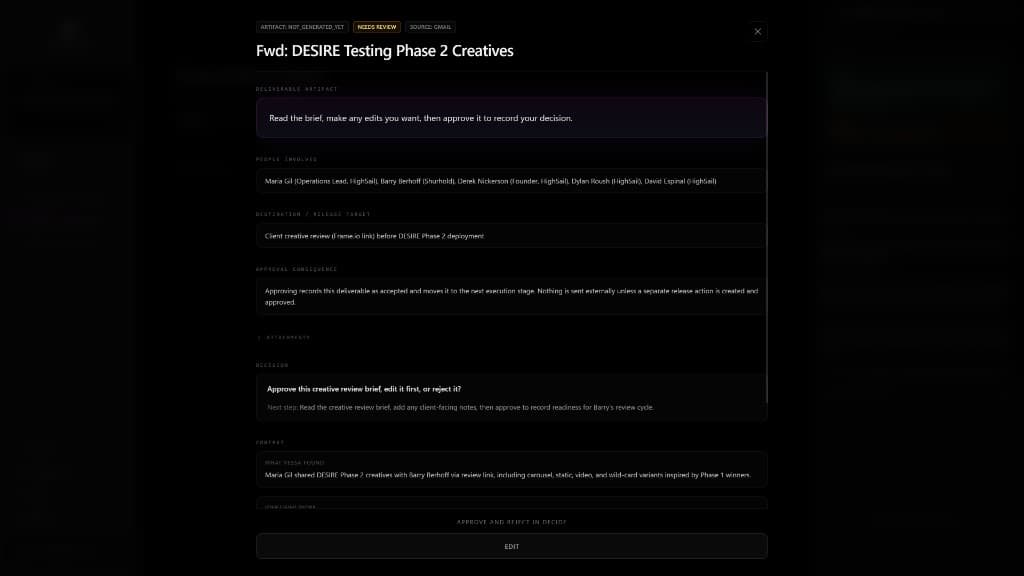
Lane 2
Deliverable review
Work product is built and held for your review before it goes to a client or team.
A layer across the tools you already run
Email, CRM, projects, and chat stay where they are. Vessa connects signal to prepared work between them.
Inputs
- CRM
- Project tools
- Documents
- Calendar
- Chat
- Forms
- Detects
- Interprets
- Creates
- Routes
- Records
Outputs
- Tasks
- Approvals
- Deliverables
- Follow-ups
- Execution history
Where this shows up in the week
Missed follow-up risk
- Signal
- A client email sits past the usual response window.
- Prepares
- Follow-up draft, owner, and due checkpoint.
- Decision
- Approve send, revise, or hold.
- Outcome
- Follow-up sent or escalated — logged either way.
Client approval received
- Signal
- A client signs off in email.
- Prepares
- Next-step tasks, team notice, and project update.
- Decision
- Confirm the move set or adjust before it runs.
- Outcome
- Work moves without someone re-entering the thread.
Proposal needs next step
- Signal
- A positive reply — then silence.
- Prepares
- Follow-up sequence, CRM update, and owner task.
- Decision
- Approve outreach or change approach.
- Outcome
- The deal keeps moving instead of aging in the inbox.
Deliverable ready for review
- Signal
- A milestone approaches with no package ready.
- Prepares
- Delivery artifact from project context and threads.
- Decision
- Review, revise, or approve release.
- Outcome
- Deliverable ships with your sign-off on record.
How operating work should run
Today
- Founders chase signals across tools
- Context lives in threads and memory
- Work gets created by hand
- Follow-through depends on who remembers
With Vessa
- Signals become prepared paths
- Work arrives with context attached
- You approve what carries consequence
- Direction stays with leadership
See how it works before you trust a metric
No customer proof on this page yet. What we can show now: how the product works, what it prepares, and how approval is built in.
Founder story
Built because follow-through kept breaking between signal and done — not because the business lacked dashboards.
Product philosophy
Prepare first. Approve when consequence is real. Record what happened. No black-box moves.
Workstream surface
Real product — where prepared work lands before approval or completion.
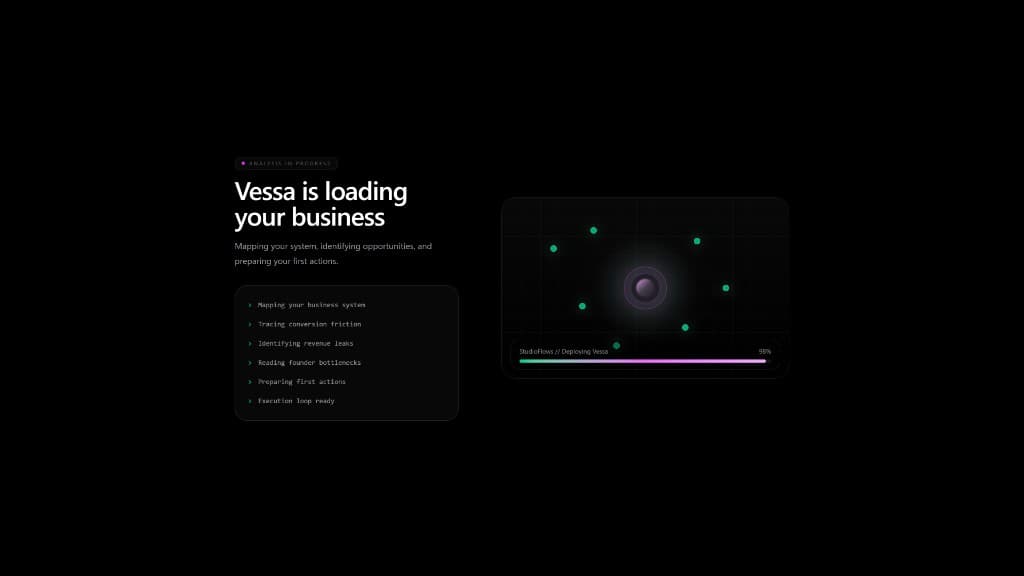
Example execution loop
Real product — ramp-up maps your stack before the first prepared item.
Approval checkpoint
Real product — action approval before a consequential move runs.
Deliverable review
Real product — review the artifact before release.
Walk one loop on your stack.
No pitch deck required. See what gets prepared, what needs your approval, and what gets recorded.